
Burette Infusion Set Explained: 100ml & 150ml Sets for Paediatric and NICU IV Therapy
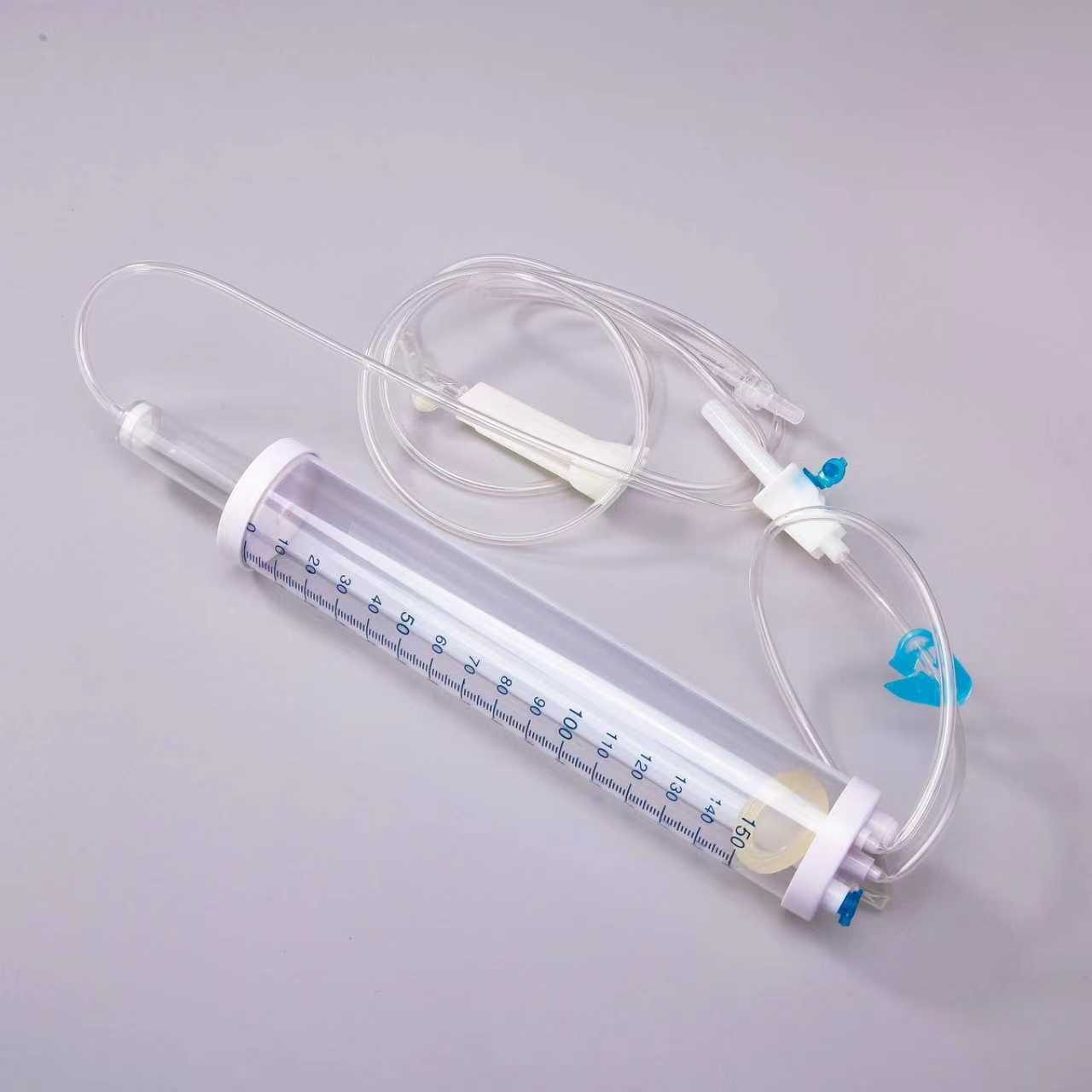
Quick orientation. A burette infusion set — also called a volume-control set, a paediatric burette, or a graduated-chamber IV set — is the standard manual safeguard against accidental IV over-infusion in paediatric, neonatal and small-volume adult therapy. It looks like a normal IV set with one critical addition: a transparent, graduated measuring chamber of 100 ml or 150 ml sits between the spike and the drip chamber, letting the clinician pre-measure exactly the volume to be delivered and then close the upper line. This guide walks through what a burette set is, how to use it, when to specify it instead of a standard set or an IV pump, and the procurement specifications hospital buyers should write into tenders.
1. What is a burette infusion set?
A burette infusion set is a single-use, sterile IV administration set with a calibrated measuring chamber (the "burette") interposed between the IV bag and the drip chamber. The set is designed for gravity-feed delivery and is used wherever a clinician needs to cap the maximum volume a patient can receive in one infusion interval — typically because the patient is small (paediatric, neonatal), fragile (cardiac or renal failure), or because the medication is being administered as a small-volume bolus that must not run on.
The chamber is graduated in millilitres (typically 1 ml increments) so the clinician can pour off exactly the prescribed volume, close the upper roller clamp to isolate the burette from the source bag, and then let the patient receive only what is in the burette. Once the burette empties, flow stops — even if the clinician is busy at another bed. That ceiling property is the entire reason burette sets exist as a separate SKU.
Two chamber sizes dominate the global catalogue: 100 ml for neonatal and smaller paediatric use, and 150 ml for older paediatric and small-volume adult titration. Manufacturers usually offer both sizes from the same assembly line as separate SKUs.
2. Anatomy of a burette set
Reading top-to-bottom from the IV bag toward the patient, a burette infusion set comprises:
- Piercing spike — punctures the IV bag or bottle. Often paired with an air vent for use with rigid bottles.
- Upper roller clamp — between the spike and the burette chamber. Closing this clamp isolates the burette from the source bag once the desired volume has been filled. This is the safety-critical control on a burette set.
- Burette measuring chamber — the defining component. Transparent, rigid, graduated in millilitres up to 100 ml or 150 ml. Includes a small air-vent at the top of the chamber so the burette can refill or drain without forming a vacuum.
- Drip chamber — sits below the burette and lets the clinician count drops and see fluid flow. On a paediatric burette set, the drop former is typically microdrip (60 drops/ml), producing small drops appropriate for slow flow rates and small total volumes.
- IV tubing — medical-grade flexible tubing connecting the drip chamber to the patient end. Length is configurable per OEM order.
- Lower roller clamp — between the drip chamber and the patient. This is the everyday flow-control clamp; the nurse uses this one to set drip rate against the chamber.
- Y injection port — self-sealing side port for administering secondary medication directly into the running line. Common on adult and older paediatric burette sets.
- Luer connector — terminates the line. Luer Lock is the safer default for paediatric use because the connector is closer to the patient and movement is unpredictable; Luer Slip remains a valid option for short, stable connections.
3. 100 ml or 150 ml — which size to specify
The two volumes serve overlapping but distinct populations.
| Burette volume | Typical patient population | Typical use cases |
|---|---|---|
| 100 ml | Neonates, infants, smaller paediatric patients | Hourly maintenance fluid, small-volume antibiotic, electrolyte bolus, intermittent micro-dose infusion |
| 150 ml | Older paediatric patients, small-volume adult titration | Two-hour maintenance fluid window, slow titrated medication, post-operative paediatric care, antibiotic infusion in adolescents |
Most paediatric and neonatal wards standardise on one size to avoid trolley confusion; some larger hospitals stock both, splitting by ward (NICU on 100 ml, general paediatric ward on 150 ml). When tendering, treat the two volumes as separate SKUs with separate MOQ and lot-traceability requirements.
4. Drop factor: why microdrip is the default
A burette set's drip chamber is almost always a microdrip chamber, 60 drops/ml. The reason is arithmetic, not regulatory.
Consider a typical paediatric prescription: "Infuse 40 ml of ceftriaxone over 60 minutes". With a microdrip chamber, the drip rate is 40 ml × 60 drops/ml ÷ 60 min = 40 drops/min, which the nurse can easily count against the wall clock. With a standard macrodrip set at 20 drops/ml, the same prescription gives 13.3 drops/min — too slow to verify by counting drops over short intervals, and prone to error. For deeper background on drop factors and how they are calibrated across set types, see our Infusion Set Components, Types & Compatibility Guide.
Macrodrip burette sets do exist (typically 20 drops/ml) for adult slow-rate use, but they are a minority SKU and not interchangeable with microdrip sets on the same trolley. Always specify the drop factor as an explicit number in the purchase order.
5. Clinical indications: when a burette set is the right choice
A burette set should be specified in the following clinical scenarios:
- Paediatric maintenance fluid. The treating physician can prescribe hourly volume, and the nurse can refill the burette every hour or two without exposing the child to the full bag.
- Neonatal intensive care (NICU). Infants tolerate very narrow fluid windows; even a slow-running 250 ml bag could cause fluid overload if left unattended. The 100 ml burette puts a hard ceiling on per-interval volume.
- Small-volume intravenous medication. Antibiotics, antifungals, anti-emetics and analgesics that need to be diluted to 20–50 ml and infused over 30–60 minutes are ideal for a burette workflow. The clinician dilutes inside the burette and runs it to empty.
- Carefully titrated therapy. Vasoactive medications, electrolyte replacement (potassium, magnesium), insulin infusions, and some chemotherapy regimens benefit from a volumetric ceiling alongside drip-rate control.
- Adult patients with restricted fluid balance. Cardiac, renal and elderly patients with narrow fluid tolerance.
- Lower-resource and transport settings. Where infusion pumps are unavailable, the burette set offers a manual safety net that an unmonitored gravity drip from a 500 ml bag does not.
Conversely, a burette set is not indicated when the intent is to deliver the full source bag at a steady rate (routine adult fluid replacement, blood transfusion, large-volume resuscitation). For these, a standard Luer Lock infusion set or blood transfusion set is the correct SKU.
6. How to use a burette set: step-by-step
The user instructions below summarise the universal manual workflow. Always follow your hospital's local protocol and the manufacturer's instructions-for-use (IFU) that ship with the set.
- Verify the prescription. Confirm patient identity, fluid type, volume, rate and any drug additive in line with your "five rights" or equivalent medication-administration policy.
- Prepare the set under aseptic technique. Open the sterile blister, close both roller clamps before piercing.
- Spike the IV bag and hang it on the drip stand.
- Open the upper roller clamp and fill the burette to the prescribed volume by watching the graduated scale. When the meniscus reaches the target line, close the upper roller clamp immediately. This is the safety-critical step — the patient cannot receive more than the volume currently in the burette.
- Open the burette air-vent if it is not already open (so fluid can drain without vacuum lock).
- Prime the drip chamber and tubing by partly squeezing the drip chamber and opening the lower roller clamp until air is flushed from the line.
- Connect to the IV cannula at the patient end via the Luer connector.
- Set the flow rate using the lower roller clamp against the drip chamber, counting drops per minute calculated from the microdrip drop factor and prescribed rate.
- Document burette fill volume, start time, drop rate and any drug additive on the IV chart.
- Refill or replace when the burette empties, following the prescription. To deliver the next aliquot, re-open the upper roller clamp, fill again, close, and continue.
Two common mistakes during use: forgetting to close the upper roller clamp (which negates the volumetric ceiling), and forgetting to open the burette air vent (which causes the chamber to lock and flow to stop). Both are avoided by counting roller-clamp positions as part of the documentation step.
7. Burette set vs. standard IV set vs. IV pump
All three devices deliver fluid intravenously, but their control mechanisms and cost structures differ.
| Attribute | Standard IV set | Burette set | Volumetric IV pump |
|---|---|---|---|
| Volume ceiling | Full bag (no manual ceiling) | Pre-measured volume in burette chamber | Programmed by user; software-enforced |
| Rate control | Roller clamp + visual count | Roller clamp + visual count on microdrip chamber | Programmed; verified by sensor |
| Alarms (occlusion, air, end) | None | Visual only — flow stops when burette empties | Audible and visual |
| Capital cost | Low (consumable only) | Low–moderate (consumable only) | High (device + matched consumable) |
| Best fit | Routine adult fluid replacement | Paediatrics, NICU, small-volume titration | High-acuity adult & paediatric ICU; weight-based infusion |
A burette set is the natural manual middle-ground between an unconstrained gravity set and a programmed pump. Hospitals with mature paediatric services typically run all three workflows in parallel, choosing per-patient based on acuity and resource availability.
8. Common brand names for burette sets
Outside the engineering literature, burette sets are sometimes called by brand names that have entered everyday hospital vocabulary in particular regions — Soluset, Buretrol, Volutrol, Metriset and others. These are trademarks of their respective owners and refer to commercial burette infusion sets from major manufacturers; functionally, all are burette / volume-control sets in the same ISO 8536 device family. For a buyer's-side comparison of brand-name and generic equivalents — including how to specify a non-branded substitute in a tender — see our companion article Soluset, Buretrol & Volutrol vs Generic Burette Infusion Set.
9. Specifying a burette set for tender
A complete tender specification for a burette infusion set should include:
- Burette chamber volume — 100 ml or 150 ml, with graduation interval (typically 1 ml increments) and chamber transparency.
- Drop factor — written as an explicit number (commonly 60 drops/ml microdrip; specify 20 drops/ml only if you intend a macrodrip burette).
- Components included — spike type (vented or non-vented), upper roller clamp, burette air vent, drip chamber, lower roller clamp, Y injection port (yes/no), Luer connector type at the patient end.
- Tubing length and material — typical length 150–200 cm; material declaration including the plasticiser system for the PVC (or non-PVC tubing on request).
- Sterilisation method — ethylene oxide (EO) is conventional; specify EO residual report per ISO 10993-7.
- Latex content statement for every elastomeric component (Y port, drip-chamber gasket, spike seal).
- Single-use / disposable marking with intended single-patient single-use.
- Standards reference — the ISO 8536 family (ISO 8536-4 for gravity-feed performance; sub-parts cover burette and accessory devices); for blood products, ISO 1135-4. Confirm the certificate on the manufacturer's Declaration of Conformity, not the marketing copy.
- Quality system and CE — ISO 13485:2016 certified manufacturer; CE marking under EU MDR for European destinations; country-specific registration (ANVISA, COFEPRIS, SFDA, NAFDAC, Kemenkes, etc.) where required.
- Packaging — individual sterile blister, units per inner box, units per master carton, lot number, expiry, shelf-life remaining at delivery.
For the wider supplier-vetting workflow that surrounds these technical points, see How to Choose a Disposable Manufacturer for Bulk Import. The same principles apply to burette IV-set manufacturers.
10. Common buyer and clinical mistakes
- Substituting a "big drip chamber" set for a burette. A big drip-chamber set has an enlarged drip chamber for visibility, but no graduated measuring chamber. It does not provide the volumetric ceiling. See our big drip-chamber set vs burette set for the device-level difference.
- Mixing 100 ml and 150 ml sets within the same SKU code. Stock them as separate SKUs with separate lot codes. Mixing makes paediatric prescriptions ambiguous.
- Mixing microdrip and macrodrip burette sets on the same trolley. A nurse who calculates drops/min for microdrip and grabs a macrodrip set will under-deliver by a factor of three. Always single-source the drop factor per ward.
- Forgetting to close the upper roller clamp. A burette is only a volume ceiling if the upper clamp is closed after filling. Train staff to verify this as part of the documentation step.
- Forgetting to open the burette air vent. A vacuum-locked burette will appear "stopped" while the patient is in fact receiving nothing. Train staff to verify drip chamber flow visually before walking away.
- Using burette sets where an IV pump is clinically indicated. A burette is a manual safety device; it is not a substitute for programmed-rate alarms on high-acuity infusions.
11. Frequently asked questions
What is a burette infusion set?
A burette infusion set (also called a volume-control set, paediatric burette set, or graduated-chamber IV set) is a single-use IV administration set with a transparent, graduated measuring chamber — typically 100 ml or 150 ml — fitted between the spike and the drip chamber. The clinician fills the chamber with a defined volume of fluid, then closes the upper roller clamp so that the patient cannot receive more than that pre-measured volume, even if the line is left unattended. It is the standard manual safeguard against accidental over-infusion in paediatric, neonatal and small-volume adult IV therapy.
When should a burette set be used instead of a standard IV set?
Use a burette set whenever the prescribed IV volume is small relative to the source bag, the patient cannot tolerate accidental over-infusion (paediatric, neonatal, elderly, cardiac or renal failure), or the medication is being carefully titrated (small-volume antibiotics, electrolyte replacement, chemotherapy). Use a standard IV set for routine adult fluid replacement where the full bag is intended to be delivered.
What is the difference between a 100ml and a 150ml burette set?
The two sizes differ only in the maximum volume of the graduated measuring chamber. 100 ml sets are typical for neonatal and smaller paediatric patients where a single dose rarely exceeds 100 ml; 150 ml sets are used when a larger pre-measured volume is needed (older paediatric patients, adult titration, two-hour maintenance fluid bolus). Procurement teams usually stock both as separate SKUs because each ward standardises on one size.
Why do burette sets use a microdrip (60 drops per ml) chamber?
A microdrip chamber produces a small drop (1/60 ml). When the clinician must deliver a small volume slowly — for example 40 ml of antibiotic over one hour to an infant — counting 40 drops per minute on a microdrip set is achievable by eye, whereas a macrodrip set at 20 drops/ml would require counting roughly 13 drops/min, harder to verify accurately. Microdrip is the conventional configuration for paediatric and slow-rate IV therapy; macrodrip burette sets exist for adult use but are less common.
Can a burette set replace an IV infusion pump?
In some clinical scenarios, yes. A burette set provides a volumetric ceiling (you cannot deliver more than the volume you placed in the chamber) and gravity-fed rate control via the roller clamp. An IV pump provides programmed-rate control and alarms but is more expensive and not always available, particularly in lower-resource settings or during transport. Many hospitals use both: burette sets for routine paediatric maintenance and titration, pumps for high-acuity, weight-based vasoactive or critical-rate infusions.
What specifications should a hospital tender request for a burette infusion set?
Specify burette volume (100 ml or 150 ml) with graduation interval, drop factor (commonly microdrip 60 drops/ml), the components included (spike type, drip chamber, roller clamp, Y injection port, connector type), connector at the patient end (Luer Lock or Luer Slip), tubing length, material declarations (PVC plasticiser system; latex content statement), sterilisation method (EO), the ISO standard reference (ISO 8536 family), and certification (CE, ISO 13485). Ask for the manufacturer's Declaration of Conformity and country-specific registration where applicable.
12. Summary and how to request a quote
A burette infusion set is the standard manual safeguard against IV over-infusion. The 100 ml and 150 ml graduated measuring chambers, combined with a microdrip drop former, let nurses pre-measure a defined volume and run the patient down to zero with no risk of the full bag emptying through the line. Where infusion pumps are scarce, on transport, or in resource-constrained paediatric services, the burette is the front-line safety device. Where pumps are deployed, the burette is still the preferred consumable for routine paediatric maintenance fluid and small-volume medication delivery.
HEZE YINUO MEDICAL manufactures the 100 ml / 150 ml burette infusion set alongside the full infusion-set family — Luer Lock, Luer Slip, Y-port, big drip-chamber and blood transfusion sets. We ship to distributors and hospital networks in 50+ countries under CE and ISO 13485:2016. Send us your specification (burette volume, drop factor, connector type, Y-port option, tubing length, packaging, destination market) and we will respond within one working day with applicable certifications, MOQ, lead time and a tiered quote. Request a quote
Related reading
- Soluset, Buretrol & Volutrol vs Generic Burette Infusion Set: Brand-Name vs OEM Equivalent Guide
- Infusion Set Components, Types & Compatibility: A Complete Guide
- Luer Lock vs Luer Slip Syringes: Which to Choose for Your Application
- How to Choose a Disposable Manufacturer for Bulk Import (2026 Guide)
- Browse all infusion-set product pages — full size and variant range