
Soluset, Buretrol & Volutrol vs Generic Burette Infusion Set: Brand-Name vs OEM Equivalent Guide
Trademark notice. Soluset®, Buretrol®, Volutrol® and Metriset® are trademarks of their respective owners. This article uses these names descriptively to explain the device category and to help hospital buyers and distributors navigate brand-name searches. No affiliation, endorsement or equivalence with the trademark owners is claimed or implied.
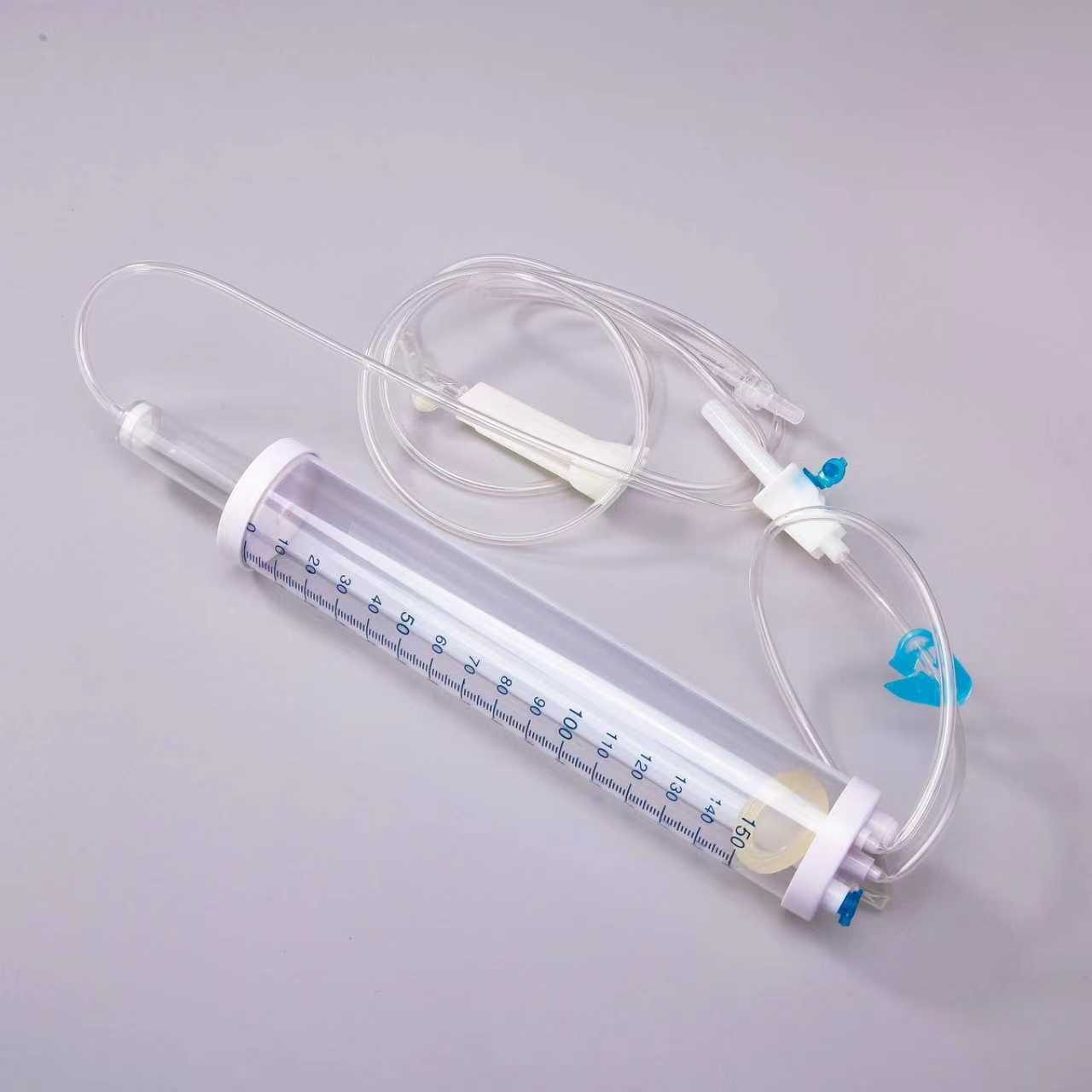
Quick orientation. Hospital buyers searching for "Soluset 100ml", "Buretrol price", "Volutrol equivalent" or "Metriset alternative" are almost always looking for the same underlying device: a burette / volume-control IV infusion set with a graduated measuring chamber, typically 100 ml or 150 ml, used for paediatric and small-volume IV therapy. The brand names entered hospital vocabulary decades ago and persist long after the clinical category has acquired a settled generic name. This article explains what each brand refers to, why the names persist, and — most usefully for procurement — how to write a brand-neutral tender so you can accept quotations from any compliant supplier without legal exposure.
1. The brand-name phenomenon in IV consumables
Medical consumables are full of brand names that have crossed the boundary into everyday clinical speech. Nurses ask the store for "a Soluset" the same way office workers ask for "a Kleenex" — the brand stands in for the device category. For procurement and quality teams, this informal habit creates two specific risks:
- Specification drift. A tender written as "supply 50,000 Solusets per year" is technically asking for the trademarked product. If you accept a quotation from a different manufacturer and book it against that tender, the audit trail is messy.
- Substitution ambiguity. The brand name does not specify burette volume, drop factor or connector type. The hospital may have been issuing 150 ml microdrip sets under that brand for ten years; if you award a contract for "Solusets" without the engineering spec, your new supplier could legally ship 100 ml macrodrip sets and the nurses on the ward would discover the substitution mid-shift.
Both problems are solved by the same fix: write tender specifications in generic functional terms and treat the brand name purely as a hint about which device category the requester has in mind.
2. What Soluset, Buretrol, Volutrol and Metriset all refer to
All four trademarks describe variants of the same underlying device — a single-use, sterile IV administration set with a graduated measuring chamber between the spike and the drip chamber. The clinician pre-fills the chamber with the volume to be delivered, then closes the upper roller clamp; the patient cannot receive more than the volume currently in the burette. For the full device-level walkthrough see our companion article Burette Infusion Set Explained: 100ml & 150ml Paediatric IV Guide.
Soluset®
A brand name used internationally for paediatric burette / volume-control IV sets. Particularly common in Spanish- and Portuguese-speaking healthcare systems (Latin America, Spain, Portugal). In many hospital protocols the word "Soluset" is used as a synonym for any paediatric burette set, even when the unit on the trolley is from a different manufacturer.
Buretrol®
A long-established brand name for burette IV sets, widely used in North American hospital vocabulary and in countries that historically imported US medical consumables. Buretrol is essentially the US-centric equivalent of the term "burette set" in nurse-to-nurse conversation.
Volutrol®
Another long-standing brand name for paediatric volume-control IV sets. Volutrol shows up in older nursing textbooks and is still used in some hospital systems. As with Soluset and Buretrol, the brand refers to the same generic device class.
Metriset®
A brand name used in certain Asian and Middle-Eastern markets for paediatric burette sets. Search engines pick up "Metriset" queries in the same way they pick up "Buretrol" — a buyer looking for a generic burette will sometimes phrase the query using whichever brand was on their procurement file last.
Other regional names
You may also encounter "paediatric burette", "volume-control set", "VCS", "graduated chamber set" and "paediatric IV set" used interchangeably in tender documents from different markets. All refer to the same device category. The cleanest procurement vocabulary is "burette infusion set" qualified by chamber volume and drop factor.
3. Are they all interchangeable?
Functionally — at the level of "what does this device do clinically" — yes. All burette infusion sets share the same anatomy: spike, upper clamp, graduated chamber, drip chamber, tubing, lower clamp, optional Y port, and Luer connector. A nurse trained on a Soluset can use a Buretrol or a generic OEM burette set without retraining.
At the engineering level, however, branded products from different manufacturers will differ in their specific dimensions, materials and drop factor:
- Chamber volume. 100 ml and 150 ml are the two dominant sizes globally, but some brand variants exist at 110 ml, 130 ml, or even larger.
- Drop factor. Microdrip 60 drops/ml is the conventional default; some macrodrip burette variants exist for adult use. Mixing them on the same ward is a known cause of paediatric medication errors, so always confirm the explicit number.
- Connector type. Luer Lock or Luer Slip at the patient end. Confirm which one mates with the IV cannula stock on the receiving ward.
- Tubing length and material. Differences here affect priming volume and dead-space calculations, which matter for accurate dosing in neonatal infusions.
- Plasticiser and latex content. Modern hospital tenders increasingly require DEHP-free tubing and latex-free elastomers. Confirm what your supplier ships and what the customer hospital requires.
- Regulatory file. CE, FDA 510(k), ANVISA, COFEPRIS, SFDA, NAFDAC, Kemenkes — each market has its own registration. The brand name does not guarantee any particular country's registration.
Bottom line: you cannot substitute a generic burette set for a branded one on the assumption that brand names alone guarantee equivalence. Verify the engineering specification.
4. Why hospital buyers still search by brand name
Three reasons brand names persist in IV-consumable procurement:
- Clinical training. Nursing schools and ward-based induction often used branded products for hands-on practice; the brand name becomes part of how the device is recalled and referred to.
- Tender legacy. Many hospital tenders are revisions of prior-year tenders. If "Soluset" appeared in the 2018 specification, it tends to survive in the 2026 specification unless someone actively cleans up the language.
- Distributor catalogues. National distributors sometimes label even generic products with familiar brand-style codes (e.g. "Distributor X Burette IV Set — Soluset-style 100ml"), reinforcing the brand-name habit.
None of these are wrong; they just mean that the procurement function has to do the translation from brand language into a specification. The supplier side has to read the brand language correctly — recognising that "Soluset 150ml microdrip Luer Lock" is a perfectly intelligible request for a 150 ml burette set with 60 drops/ml microdrip and a Luer Lock connector.
5. How to write a brand-neutral tender for a burette set
If you are responsible for hospital procurement or for a distributor tender that previously named brand products, here is a clean specification template:
Burette volume: 100 ml [or 150 ml], graduated in 1 ml increments, transparent rigid chamber.
Drop factor: 60 drops/ml microdrip [confirm explicit number].
Components: piercing spike, upper roller clamp, burette chamber with air vent, drip chamber, lower roller clamp, Y injection port (latex-free), Luer Lock [or Luer Slip] connector at patient end.
Tubing: medical-grade flexible tubing, length 150–200 cm; plasticiser system declared (DEHP-free preferred for paediatric / neonatal use).
Sterilisation: ethylene oxide (EO), EO residual report per ISO 10993-7.
Single use: single-patient single-use, blister packed individually.
Quality system: manufactured under ISO 13485:2016.
Certification: CE marked under EU MDR for European destinations; country-specific registration as applicable.
Brand: any supplier brand or OEM private label acceptable, provided the above specification is met and the regulatory file is verifiable.
A specification of this form is brand-neutral, audit-defensible, and welcomes quotations from any compliant supplier. It also has the SEO side effect of making the buyer comfortable accepting quotations from a manufacturer they had not previously heard of, since the spec — not the brand — is what defines the device.
6. Sourcing an OEM equivalent — what to verify
When a buyer accepts an OEM or generic equivalent from a non-branded supplier, the diligence checklist for first orders typically includes:
- Manufacturer's ISO 13485:2016 certificate — valid expiry, named scope including infusion sets.
- CE certificate or country-specific medical-device registration for the destination market.
- Free Sales Certificate from the country of manufacture — useful for customs and re-registration.
- Engineering drawing or product datasheet confirming burette volume, drop factor, connector type, tubing material and length.
- Sterilisation validation report including EO residual per ISO 10993-7.
- Biocompatibility statement per ISO 10993-1.
- Latex declaration on every elastomeric component.
- Sample units for clinical evaluation before bulk PO.
- OEM packaging artwork — confirm the artwork does NOT use any other manufacturer's trademark.
- Lot traceability arrangement and country-of-origin labelling.
For the wider supplier-vetting framework these documents fit into, see CE vs ISO 13485 vs FDA: A Medical Device Importer's Compliance Guide and How to Choose a Disposable Manufacturer for Bulk Import.
7. Common procurement mistakes when sourcing a generic burette set
- Asking for "the cheapest Soluset equivalent". Cheapest is not a specification. A 100 ml macrodrip set is cheaper than a 100 ml microdrip set, but functionally is not what your paediatric ward needs. Specify the drop factor.
- Accepting "DEHP-free" as a marketing claim without a material declaration. The plasticiser is in the tubing, not the packaging. Require a material declaration from the manufacturer, not just a logo on the carton.
- Authorising a supplier to use a trademark in OEM packaging without permission. If the supplier prints "compatible with Soluset" on the carton without authorisation from the trademark owner, the carton can be detained at customs and the buyer carries the exposure.
- Skipping the connector check. If the receiving ward stocks Luer Slip cannulas and your new burette set is Luer Lock-only, the clinical staff will improvise — and improvised IV connections are a quality event in any modern hospital.
- One-time sample without a contract clause for spec consistency. Some suppliers ship gold-standard samples and bulk orders that drift. Negotiate a contractual obligation that bulk product matches the validated sample.
8. Frequently asked questions
Are Soluset, Buretrol and Volutrol the same as a generic burette infusion set?
Functionally, yes. Soluset®, Buretrol® and Volutrol® are brand names used by various medical-device manufacturers for paediatric burette / volume-control IV sets. They all describe the same device class: a single-use IV administration set with a graduated measuring chamber (typically 100 ml or 150 ml) between the spike and the drip chamber. Each manufacturer's specific product carries its own dimensions, materials, drop factor and regulatory registrations, so buyers should always verify the engineering specification rather than rely on brand-name equivalence alone.
Are Soluset, Buretrol and Volutrol trademarks?
Yes. Soluset®, Buretrol®, Volutrol® and Metriset® are trademarks of their respective owners. They are sometimes used informally in hospital practice as if they were generic terms (similar to how "Kleenex" is used for any facial tissue), but legally they remain registered marks and tender documents should use neutral generic language — "burette infusion set" or "volume-control set" — to describe the device class.
Can I source an OEM equivalent of Soluset or Buretrol from a Chinese manufacturer?
You can source a generic burette infusion set with comparable design from many CE/ISO 13485 certified Chinese manufacturers. What you should not do is claim brand equivalence on the packaging without authorisation from the trademark owner. Instead, specify the device by its functional and regulatory attributes (burette volume, drop factor, connector, certifications), accept the supplier's brand or OEM private label, and verify the regulatory file independently.
How do I write a brand-neutral hospital tender for burette infusion sets?
Replace the brand name with a generic device descriptor and append the functional specification: "Disposable burette / volume-control IV infusion set; graduated measuring chamber 100 ml [or 150 ml]; drop factor 60 drops/ml microdrip; Luer Lock connector; latex-free Y injection port; EO sterilised; manufactured under ISO 13485:2016 quality system; CE marked under EU MDR (or local equivalent registration)." This language is brand-neutral, audit-defensible, and lets you accept quotations from multiple compliant suppliers.
Why do clinicians keep using brand names instead of the generic term?
Brand names are short, memorable and entered hospital training materials decades before the generic device category had a settled name. They persist because changing clinical vocabulary is hard. The procurement risk is that a nurse asking the store for "a Soluset" may be issued any burette set the hospital stocks — which is fine clinically, but only if the procurement spec was written in functional terms so the alternative product is genuinely equivalent.
9. Summary and how to request a quote
Soluset, Buretrol, Volutrol and Metriset are brand-name labels for the same underlying device — a paediatric burette / volume-control IV infusion set. For hospital procurement and OEM sourcing, the safest workflow is to set the brand language aside, write the tender in generic functional and regulatory terms, and accept quotations from any compliant supplier whose product matches the specification.
HEZE YINUO MEDICAL manufactures a generic 100 ml / 150 ml burette infusion set alongside the full infusion-set family — Luer Lock, Luer Slip, Y-port, big drip-chamber and blood transfusion sets. We are CE marked and ISO 13485:2016 certified, ship to distributors in 50+ countries, and accept OEM private-label orders. We do not authorise the use of third-party trademarks (Soluset, Buretrol, Volutrol, Metriset or others) on our packaging. Send us your specification — burette volume, drop factor, connector type, Y-port option, packaging and destination market — and we will respond within one working day with applicable certifications, MOQ, lead time and a tiered quote. Request a quote
Related reading
- Burette Infusion Set Explained: 100ml & 150ml Paediatric IV Guide
- Infusion Set Components, Types & Compatibility: A Complete Guide
- CE vs ISO 13485 vs FDA: A Medical Device Importer's Compliance Guide
- How to Choose a Disposable Manufacturer for Bulk Import (2026 Guide)
- Browse all infusion-set product pages — full size and variant range