
IV Drip Rate & Drop Factor: Macro-drip vs Micro-drip — Calculation & Selection Guide
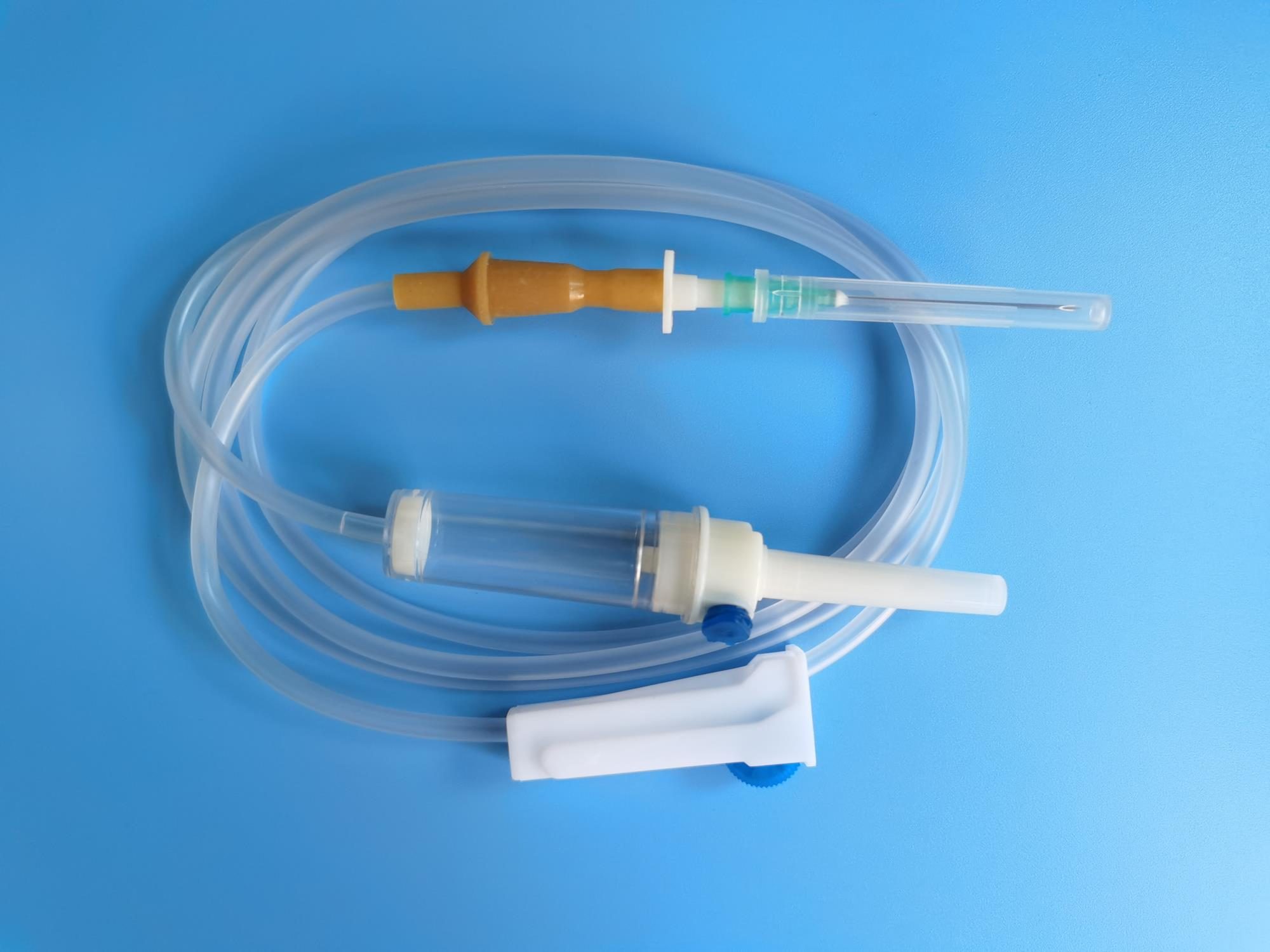
Quick answer. The drop factor (drip factor) of a gravity IV infusion set is the number of drops it delivers per millilitre of fluid — printed on the pack as gtt/ml. Macro-drip sets deliver 10, 15 or 20 gtt/ml and are used for adult fluid therapy and rapid infusion; micro-drip (paediatric) sets deliver 60 gtt/ml and are used for children, low-volume medication and precise titration. The manual flow rate in drops per minute is (volume in ml × drop factor) ÷ time in minutes. This guide covers the two families, the calculation with worked examples, fast mL/h-to-drops conversions, when to use each, and how to specify drop factor correctly when you buy IV sets in bulk. Request an IV set quote
1. What "drop factor" (gtt/ml) actually means
The drop factor is fixed by the geometry of the drop former — the small calibrated nozzle inside the drip chamber that breaks fluid into drops of a constant size. A larger orifice makes bigger drops (fewer per ml); a finer orifice makes smaller drops (more per ml). Because the drop volume is fixed, counting drops per minute against a watch gives a reliable gravity flow rate without a pump. The drop factor is printed on every compliant set — read it, because every manual flow-rate calculation depends on it.
Two families dominate the market: macro-drip and micro-drip. They are physically different SKUs — you cannot change the drop factor of a set after manufacture.
2. Macro-drip vs micro-drip — the two families
| Attribute | Macro-drip | Micro-drip (paediatric) |
|---|---|---|
| Drop factor (gtt/ml) | 10, 15 or 20 | 60 |
| Drop size | Large | Small (about ⅓–⅙) |
| Typical patients | Adults | Paediatric / neonatal |
| Typical use | Fluid replacement, rapid infusion, resuscitation | Low-volume medication, KVO, precise titration |
| Practical flow range | Medium–high | Low |
| Dose accuracy at low rates | Lower | Higher |
Macro-drip drop factors vary by manufacturer and region — 20 gtt/ml is the most common international default, 15 gtt/ml is widely used, and 10 gtt/ml exists for rapid infusion. Micro-drip is standardised at 60 gtt/ml worldwide.
3. The gravity flow-rate formula (with worked examples)
Drops per minute (gtt/min) = (Volume in ml × Drop factor in gtt/ml) ÷ Time in minutes
- Adult, 20 gtt/ml. 1,000 ml over 8 h (480 min): 1000 × 20 ÷ 480 ≈ 42 gtt/min.
- Same order, 15 gtt/ml. 1000 × 15 ÷ 480 ≈ 31 gtt/min — a different count for the same prescription.
- Paediatric, 60 gtt/ml micro. 100 ml over 1 h (60 min): 100 × 60 ÷ 60 = 100 gtt/min.
- KVO line, 60 gtt/ml. 20 ml/h: 20 × 60 ÷ 60 = 20 gtt/min.
The same prescription produces a different drops/min on a 15 vs 20 gtt/ml set — which is exactly why the drop factor must be known and standardised before the nurse counts.
4. Fast conversions: mL/h to drops per minute
For a constant hourly rate, divide by a fixed number that depends only on the drop factor:
| Drop factor | Shortcut (gtt/min from mL/h) | at 100 mL/h |
|---|---|---|
| 10 gtt/ml | mL/h ÷ 6 | ≈ 17 gtt/min |
| 15 gtt/ml | mL/h ÷ 4 | 25 gtt/min |
| 20 gtt/ml | mL/h ÷ 3 | ≈ 33 gtt/min |
| 60 gtt/ml | = mL/h | 100 gtt/min |
The 60 gtt/ml micro-drip has a uniquely convenient property: drops per minute equals millilitres per hour, so a 45 mL/h order is simply 45 gtt/min. This is one reason micro-drip is preferred where staff titrate low rates by hand.
5. When to specify macro-drip
- Adult fluid replacement and maintenance infusion.
- Rapid infusion and resuscitation (10 or 15 gtt/ml deliver more per drop).
- Routine adult wards, emergency department and operating theatre.
- High hourly volumes where 60 gtt/ml would require impractically fast counting.
6. When to specify micro-drip (60 gtt/ml)
- Paediatric and neonatal infusion, where over-infusion is dangerous.
- KVO / TKO ("keep vein open") lines at very low rates.
- Potent drugs that need precise low-rate titration on gravity.
- Any low-volume infusion where a small counting error is clinically significant.
For paediatric and neonatal care, pair a micro-drip with a 100/150 ml burette set so a precise volume is pre-measured before it can run — see the burette infusion set guide.
7. Gravity drop-counting vs infusion pumps
Drop factor governs manual gravity infusion. With a volumetric infusion pump, the pump controls the rate directly and the drop factor is not used in the calculation — but the set must be the pump-compatible type (a dedicated pumping segment), and most pump sets still have a drip chamber for priming and air detection. For critical or very-low-rate infusions, a pump or syringe driver is safer than drop counting; for routine fluids and lower-resource settings, gravity drop-counting remains standard. If you run a particular pump brand, specify pump-set compatibility explicitly in the tender.
8. Standards, tolerance and regional variation
Gravity IV sets are governed by ISO 8536-4, which defines the nominal drop factor and its tolerance: macro sets are calibrated so that 20 drops equal 1 ml of distilled water under defined conditions, and micro sets so that 60 drops equal 1 ml. Because macro drop factors legitimately differ (10 / 15 / 20), never assume a value — the exact gtt/ml must appear on the label and the spec sheet. Stocking sets with different drop factors on the same ward is a recognised medication-error risk.
9. Procurement guidance — what to specify and stock
- State the drop factor explicitly in the tender ("20 gtt/ml macro" or "60 gtt/ml micro"), not just "IV set".
- Require the drop factor to be printed on the unit pack and the carton.
- Standardise on as few macro drop factors as possible across the facility to cut dosing error.
- Stock a mix: macro for adult wards, ED and theatre; micro for paediatric and NICU; and burette sets for pre-measured paediatric volumes.
- Confirm ISO 8536-4 on the certificate, and specify Luer Lock vs Luer Slip, Y-port and DEHP/latex-free as separate attributes — see the infusion set components guide.
- Match pump-compatible sets to your installed infusion pumps, and match the set connector to your IV cannula.
10. Common buyer and clinical mistakes
- Assuming one universal drop factor. 15 and 20 gtt/ml both exist; the calculation differs.
- Drop factor not printed on the pack. Reject sets that do not label it.
- Using macro-drip for low-volume paediatric infusion. Counting error becomes a dosing error.
- Confusing drop factor with flow rate. Drop factor is a fixed property of the set; flow rate is what you set with the roller clamp.
- Ignoring pump-set compatibility. A gravity set on a pump — or the wrong pump segment — fails.
- Mixing 15 and 20 gtt/ml sets on the same ward. A known cause of infusion-rate errors.
As a manufacturer of the full infusion-set family — Luer Lock, Luer Slip, Y-port, 100/150 ml burette, big drip-chamber and blood transfusion sets in both macro and micro-drip — we ship to distributors and hospital networks in 50+ countries. Tell us the drop factor, connector, Y-port, DEHP/latex and packaging you need and we will reply within one working day with applicable certifications, MOQ, lead time and a tiered quote. Request a quote
11. Frequently asked questions
What is the drop factor of an IV infusion set?
The drop factor, or drip factor, is the number of drops the set delivers per millilitre of fluid (gtt/ml), fixed by the geometry of the drop former inside the drip chamber. Macro-drip sets are 10, 15 or 20 gtt/ml; micro-drip (paediatric) sets are 60 gtt/ml. It is printed on the pack and is the number every manual gravity flow-rate calculation depends on.
What is the difference between macro-drip and micro-drip?
Macro-drip sets make large drops (10, 15 or 20 per ml) and are used for adult fluid therapy and rapid infusion. Micro-drip sets make small drops (60 per ml) and are used for paediatric and neonatal patients, low-volume medication, KVO lines and precise low-rate titration. They are physically different SKUs; you cannot change the drop factor after manufacture.
How do I calculate the IV drip rate in drops per minute?
Use drops per minute = (volume in ml × drop factor in gtt/ml) ÷ time in minutes. For example, 1,000 ml over 8 hours (480 minutes) on a 20 gtt/ml set is 1000 × 20 ÷ 480 ≈ 42 drops per minute. On a 15 gtt/ml set the same order is about 31 drops per minute, which is why the drop factor must be known first.
Why does a micro-drip set deliver 60 drops per ml?
Micro-drip sets use a fine drop former standardised to 60 gtt/ml so that small volumes can be counted accurately at low flow rates. A convenient result is that drops per minute equals millilitres per hour on a 60 gtt/ml set, so a 30 ml/h order is simply 30 drops per minute — which is why micro-drip is preferred for hand-titrated paediatric infusion.
Is the drop factor relevant when using an infusion pump?
No — a volumetric infusion pump controls the flow rate directly, so the drop factor is not used in the rate calculation. However, the set must be the pump-compatible type with the correct pumping segment for your pump brand, and most pump sets still have a drip chamber for priming and air detection. Drop factor only matters for manual gravity infusion.
What drop factors should a hospital stock?
Most facilities stock a macro-drip set (commonly 20 gtt/ml, or 15 gtt/ml where that is the regional standard) for adult wards, emergency and theatre; a 60 gtt/ml micro-drip set for paediatrics and NICU; and burette sets for pre-measured paediatric volumes. Standardise on as few macro drop factors as possible and require the value to be printed on the pack to reduce dosing error.
What is the typical MOQ for IV infusion sets from a Chinese manufacturer?
Typical MOQ for standard macro or micro-drip Luer Slip or Luer Lock infusion sets is 30,000–50,000 sets per SKU. Y-port and burette variants usually start at 20,000–30,000 sets. DEHP-free or latex-free upgrades add roughly 10–25% to unit cost without changing MOQ significantly, and OEM-printed packaging adds a one-time tooling fee but no per-unit premium.
Related reading
- Burette Infusion Set Explained: 100ml & 150ml Paediatric IV Guide (2026)
- Infusion Set Components, Types & Compatibility Guide
- IV Cannula Gauge Selection Guide: 14G to 24G Use Cases
- Soluset, Buretrol & Volutrol vs Generic Burette Infusion Set (2026)
- How to Choose a Syringe Manufacturer for Bulk Import (2026)
- Browse all infusion-set product pages — full size and variant range