
Hypodermic Needle Selection Guide: Gauge, Length & Bevel for IM, SC, ID Injection and Drug Withdrawal
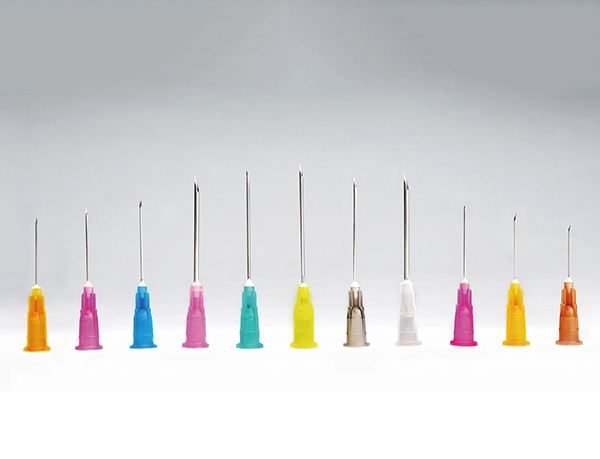
Quick orientation. The hypodermic needle is the most consumed disposable medical device worldwide — billions of units per year, across every conceivable injection, withdrawal and vaccination workflow. It is also one of the least examined SKUs in hospital and distributor inventories, because "a needle is a needle." It is not. Gauge, length, bevel geometry, siliconisation and safety mechanism each meaningfully affect clinical outcomes (vaccine efficacy, injection pain, haemolysis on blood draw, needlestick injury rate) and procurement economics (per-unit cost, MOQ, packaging, lead time). This guide walks through ISO 6009 colour coding, gauge-by-gauge use cases, length conventions, bevel design, needle subtypes (blunt-fill, blunt-tip, pen, safety), and the SKU mix that matches IM, SC, ID and drug-withdrawal workflows.
1. Hypodermic vs IV cannula — clearing up the terminology
A hypodermic needle is a standalone hollow stainless-steel needle attached to a plastic Luer hub. It is used for a single short procedure — injecting medication into muscle, subcutaneous tissue or the dermis, or withdrawing medication from a vial — and then discarded. It is not designed to remain in the body.
An IV cannula (peripheral venous catheter) is a needle-over-catheter assembly where a stainless-steel introducer needle delivers a soft plastic catheter into a vein; the needle is withdrawn and discarded, while the catheter stays in the vein for continuous IV access (covered in our IV cannula gauge selection guide).
The two devices share ISO 6009 colour coding on the Luer hub — but differ in bevel design (hypodermic bevels are optimised for tissue puncture; IV bevels are optimised for vein entry without through-puncture), length convention (hypodermic mostly in inches; IV in millimetres), packaging density, and per-unit cost. Procurement should treat them as distinct categories — running 21G × 1″ hypodermic needles for venous cannulation will not work.
Our standard hypodermic needles are produced across the full 16G–30G range with multiple length options, regular lancet and short-bevel geometry, siliconised cannula and ISO 6009 colour-coded hubs.
2. Anatomy of a hypodermic needle
A hypodermic needle has four functional parts:
- Cannula (shaft) — the hollow stainless-steel tube. Outer diameter (OD) sets the gauge; inner diameter (ID) sets the flow resistance. Material is typically 304 or 316L stainless steel. Cannula is siliconised to reduce insertion friction and patient pain.
- Bevel (tip) — the sharpened point at the patient end. Three-facet "lancet" bevel is standard for tissue puncture; back-cut and short-bevel variants exist for specific applications.
- Hub — the plastic connector at the syringe end. Luer Slip or Luer Lock depending on syringe compatibility. The hub is colour-coded by ISO 6009 standard so clinicians identify the gauge by sight.
- Cap (sheath) — the rigid plastic protective cover that ships with every needle. Removed immediately before use and re-applied (or, ideally, discarded directly into a sharps container without recapping) after use.
Safety variants add a fifth component: a passive safety shield, retracting mechanism or sliding cover that engages after withdrawal, preventing needlestick injury.
3. ISO 6009 colour coding for hypodermic needles
The international standard ISO 6009 specifies hub colour by needle gauge. The same colour code applies to IV cannula hubs, but on hypodermic needles the user has a wider gauge range to navigate (16G–30G is routine; 14G–32G in specialty product lines).
| Gauge | ISO 6009 colour | Cannula OD | Typical lengths |
|---|---|---|---|
| 16G | Grey (NB: IV cannula 16G uses grey too) | 1.65 mm | 1″–1.5″ |
| 18G | Pink (hypodermic) / Green (IV cannula) | 1.27 mm | 1″–1.5″ |
| 19G | Cream | 1.07 mm | 1″–1.5″ |
| 20G | Yellow | 0.91 mm | 1″–1.5″ |
| 21G | Green | 0.82 mm | ⅝″–1.5″ |
| 22G | Black | 0.72 mm | ½″–1.5″ |
| 23G | Deep blue | 0.64 mm | ½″–1.25″ |
| 25G | Orange | 0.51 mm | ⅜″–1.5″ |
| 26G | Brown | 0.46 mm | ⅜″–½″ |
| 27G | Medium grey | 0.41 mm | ⅜″–1.5″ |
| 29G | Red | 0.33 mm | ½″ |
| 30G | Yellow | 0.30 mm | ¼″–½″ |
Two practical notes. First, hypodermic 18G is pink and IV cannula 18G is green — same gauge, different colour, because they belong to two separate sequences within ISO 6009. Procurement that mixes the two product families in the same SKU code list will create clinical confusion. Second, the colour conventions for finer gauges (26G+) differ across regions and legacy manufacturers; for tender writing, specify "ISO 6009 compliant" rather than relying on the colour name alone.
4. Gauge-by-gauge clinical use cases
16G–18G — Drug withdrawal and high-viscosity injection
Rarely used for direct patient injection (too painful, too traumatic). Primary applications:
- Drug withdrawal from glass ampoules or rubber-septum vials — the larger ID allows fast aspiration of viscous medications (oils, concentrated antibiotics, lipid emulsions)
- Reconstitution of lyophilised drugs (powder + diluent) where viscosity is high
- Specialty injections of viscous biologics or contrast media
For drug withdrawal, the safest practice is a dedicated blunt-fill needle rather than a sharp 18G — eliminates needlestick risk during the high-frequency vial-access activity.
20G–21G — IM injection, adult vaccination, blood collection
The dominant gauges for adult IM injection. 21G × 1.5″ is the single most prescribed needle SKU worldwide.
- Adult IM injection — antibiotics, analgesics, vaccines, depot preparations
- Adult vaccination — most adult vaccines are formulated for IM, requiring 21G or 22G × 1″–1.5″
- Blood collection — 21G is the volume-leading gauge for venepuncture; haemolysis risk acceptable; flow rate good. Use a dedicated blood collection needle with multi-sample collection adaptor where vacuum tubes are involved
- Local anaesthetic infiltration for minor surgery
22G–23G — Paediatric IM, adult IM in thin patients, IV bolus injection
Finer than 21G; less painful but slower flow and not suitable for blood collection (haemolysis rate rises).
- Paediatric IM injection — 22G or 23G, ⅝″–1″ length
- Adult IM in thin patients or for deltoid site where 21G feels excessive
- IV bolus injection via an existing IV line — the medication is pushed through an IV port, not into a vein directly
- Butterfly (scalp-vein) needles for paediatric or difficult-access blood collection use 21G–23G in their needle component — see our butterfly needle sets
25G–27G — Subcutaneous injection, paediatric IM, ID
The "fine" range for low-pain superficial injection.
- Subcutaneous (SC) injection — heparin, low-molecular-weight heparin (enoxaparin), GCSF, allergy desensitisation. Typical: 25G × ⅝″ or 27G × ½″
- Intradermal (ID) injection — tuberculin skin test, allergy testing, BCG vaccination. Typical: 26G or 27G × ⅜″
- Paediatric IM in very young children or for less viscous medications
- Local anaesthetic top-up for cosmetic and dental procedures
29G–32G — Insulin pen needles, dermal aesthetic injection
The ultra-fine range, almost exclusively for repeated self-injection or precision dermal work.
- Insulin pen needles — 31G or 32G × 4 mm, 5 mm, 6 mm or 8 mm. The patient comfort gain over 25G–27G is substantial in chronic daily-injection populations
- Dermal aesthetic / cosmetic injection — fine-line injection of dermal filler precursors and similar. Many cosmetic procedures use a micro needle cannula kit (flexible blunt cannula) rather than a sharp needle, to reduce bruising
- Mesotherapy and precision aesthetic dermatology
5. Needle length conventions and how to choose
Hypodermic needle length is conventionally expressed in inches in clinical literature, in millimetres on the cannula print and in product catalogues. Reference conversion:
- ¼″ = 6 mm (insulin pen short, neonatal ID)
- ⅜″ = 10 mm (ID injection, paediatric SC)
- ½″ = 13 mm (SC, paediatric IM, blood collection)
- ⅝″ = 16 mm (paediatric IM, adult SC, deltoid IM in thin patients)
- 1″ = 25 mm (standard adult IM in deltoid)
- 1¼″ = 32 mm (standard adult IM ventrogluteal in average build)
- 1½″ = 38 mm (adult IM ventrogluteal in larger build, drug withdrawal)
- 2″ = 50 mm (adult IM in obese patients, specialty applications)
Length-by-route rules of thumb:
- ID injection — ⅜″ at 5–15° angle, bevel up; the needle never fully enters the skin
- SC injection — ⅜″–⅝″ at 45–90° (depending on tissue depth); the medication deposits in the SC layer between skin and muscle
- IM injection — 1″–1.5″ at 90°; the needle reaches muscle past the SC layer
- Drug withdrawal — 1½″ is conventional; reach into the vial and tilt to draw the last drops
Common mistake: ordering only one length per gauge to simplify inventory. Paediatric units cannot use 1.5″ needles on small children; obese-patient IM injection fails with a 1″ needle (medication deposits SC, not IM). Stock at least two lengths per high-volume gauge.
6. Bevel geometry — why one needle hurts less than another
The "bevel" is the angled cut at the tip that creates the cutting edge. Bevel design controls insertion force, tissue trauma and patient pain. Three families dominate:
- Regular bevel (lancet, three-facet) — the standard hypodermic bevel. A primary bevel cuts the skin, two side bevels widen the path. Long-bevel design (typically 14–17° primary angle). General-purpose; balances sharpness with structural integrity.
- Short bevel — primary angle around 20–24°. Less sharp but more controlled penetration, used in epidural / spinal needles, regional anaesthesia, and applications where through-puncture risk must be minimised. Not common in standard hypodermic SKUs.
- Back-cut (Huber-tip variant) — used on port-access needles and some specialty designs to avoid coring through a rubber septum. Not a standard hypodermic option.
For volume production, the three-facet regular bevel is the standard and is the bevel you should specify unless your application has a specific reason for short bevel.
Siliconisation — every quality hypodermic needle is silicone-coated to reduce friction at insertion. Inadequate or inconsistent siliconisation is a quiet quality failure that produces "stinging" injections and clinician complaints. Specify uniform medical-grade silicone coating in your tender language and request the QC release certificate.
7. Hypodermic needle subtypes — beyond standard
- Standard hypodermic needle — sharp three-facet bevel, single-use injection or drug withdrawal. The dominant SKU. Our standard hypodermic needles cover 16G–30G in inch and metric lengths.
- Blunt-fill needle — non-sharp, vial-access-only needle for pharmacy and ward medication preparation. Prevents needlestick during high-frequency vial access and prevents septum coring. Typical: 18G × 1.5″. See blunt-fill needles 18G × 38mm.
- Blunt-tip (non-coring) needle — for reconstitution and filter-needle applications where the vial septum must remain intact. Our blunt-tip needles are available across the relevant gauge range.
- Safety hypodermic needle — needle with integrated passive shield or sliding cover. Cost premium 1.5–4× vs standard; required by Needlestick Safety legislation in regulated markets.
- Insulin pen needle — ultra-fine (31G–32G), ultra-short (4–8 mm) for daily SC self-injection. Threaded hub for pen device compatibility.
- Spinal / epidural needle — specialty; long, short-bevel, with stylet. Not a standard hypodermic SKU.
- Filter needle — built-in 5 micron filter, for drawing from glass ampoules where glass shards may be present.
- Micro needle cannula — flexible blunt cannula for cosmetic aesthetic injections. See our micro needle cannula kits.
- Butterfly (winged) needle — wings provide secure grip during venepuncture or paediatric IV access. See our butterfly scalp vein sets.
- Safety blood lancet — single-use capillary blood sampling device with auto-retract mechanism. See our safety blood lancets.
8. Safety variants — the regulatory and economic picture
Safety hypodermic needles integrate a passive shield, retracting needle or sliding cover that engages after the needle is withdrawn from the patient. The mechanism varies — most commonly a hinged shield that the clinician swings over the tip with one hand, or a passive sleeve that springs forward when the needle exits the patient.
Regulatory drivers:
- US — Needlestick Safety and Prevention Act (2000), OSHA Bloodborne Pathogens Standard (29 CFR 1910.1030). Employer must use safety-engineered sharps where commercially available.
- EU — Council Directive 2010/32/EU on prevention from sharp injuries in healthcare. National implementation in every member state.
- Australia, Canada, Japan — Equivalent regulations.
- Middle East, ASEAN, LATAM tertiary tenders — Increasingly specifying safety as the default; the trend is one-way.
Cost premium: 1.5–4× standard non-safety equivalent at factory gate. Benefit: occupational health (needlestick injury rate reduction, with downstream HIV, HBV, HCV exposure avoidance) plus tender eligibility for regulated markets.
Decision rule: if your target market is US, EU, AU, JP, or any tertiary hospital network with formal needlestick policy, safety is mandatory. For unregulated markets, the premium is balanced against occupational health priority — most distributors find tender requirements are shifting toward safety as the default.
9. Bulk procurement specifications
SKU mix recommendations (adult general medical/surgical ward)
- 21G × 1.5″ — 25–30% of hypodermic SKU volume (IM injection workhorse)
- 23G × 1″ — 15–20% (paediatric IM, IV push, smaller IM)
- 25G × ⅝″ — 15–20% (SC injection)
- 18G × 1.5″ blunt-fill — 10–15% (drug withdrawal — pharmacy and ward)
- 27G × ½″ — 8–12% (SC, dental, fine injection)
- 22G × 1.5″ — 5–8% (alternative to 21G in thin adults)
- 26G–27G × ⅜″ — 3–5% (ID injection, TB testing)
- Specialty (31G–32G pen, 16G–18G specialty) — balance
Paediatric units shift toward 22G–25G short lengths and pen needles. OR weighted toward 18G blunt-fill (drug prep). Vaccination clinics weighted toward 21G–23G × 1″ (adult vaccination). Confirm hospital-specific consumption before placing initial orders.
Material and configuration options
- Cannula material: 304 or 316L stainless steel (316L preferred for higher corrosion resistance)
- Hub material: medical-grade polypropylene (PP), colour-coded by ISO 6009
- Hub type: Luer Slip or Luer Lock (must match the syringe — most hospitals stock Luer Slip for routine, Luer Lock for high-pressure / aspiration)
- Siliconisation: uniform medical-grade silicone, QC release per ISO 7864
- Sterilisation: EO sterilised, non-pyrogenic, single-use
- Packaging: individually peel-pouch sterile-packed; 100 per inner carton, 1000–10,000 per master carton
- Shelf life: typically 5 years from manufacturing date
Unit cost ranges (FOB China)
- Standard hypodermic needle (21G–27G, 1″–1.5″): USD 0.008–0.015 per piece (yes, less than a US cent at volume)
- Blunt-fill 18G × 1.5″: USD 0.015–0.030
- Blunt-tip needle: USD 0.018–0.035
- Safety hypodermic needle (passive shield): USD 0.025–0.050
- Insulin pen needle (31G–32G × 4–6 mm): USD 0.020–0.045
- Butterfly / scalp-vein set: USD 0.05–0.12
- Micro needle cannula kit: USD 0.30–0.60
- Safety blood lancet: USD 0.015–0.040
Hypodermic needles are the lowest per-unit cost device in the disposable medical category. The economics reverse on packaging (sterile peel-pouch and printed labelling become a meaningful share of cost at this price point).
MOQ and lead time
Typical MOQ is 100,000 pieces per gauge × length × hub-type combination per production run, scaling up to 500,000+ for the high-volume SKUs (21G × 1.5″). Specialty SKUs (16G, 30G+, blunt-fill, safety) may have higher per-batch MOQ because the production line tooling is more specialised. Lead time 25–40 days for standard SKUs, 40–60 days for OEM packaging or non-standard configurations.
Packaging hierarchy: individual peel-pouch sterile (one needle per pouch) → 100 per inner carton → 10–50 inner cartons per master carton (1,000–5,000 per master). For pen needles, 100-needle plastic dispensers are common. For OEM, custom box-art and multilingual labelling add a one-time tooling fee but typically no per-unit premium at volume.
10. Common procurement pitfalls
- Conflating IV cannula gauge with hypodermic gauge. Same number, different colour convention, different physical needle. 18G hypodermic (pink) and 18G IV cannula (green) are not interchangeable.
- Single-length-per-gauge ordering. Stocking only 21G × 1.5″ fails paediatric (need shorter) and obese-adult IM (need longer). Stock at least two lengths per high-volume gauge.
- Sub-spec siliconisation. Inadequate silicone coating produces "stinging" injections and quiet clinician complaints. Specify uniform medical-grade silicone in the tender and request QC release.
- Ignoring blunt-fill for vial access. Pharmacy and ward staff withdrawing from vials repeatedly with sharp 18G needles incur disproportionate needlestick risk. Blunt-fill addresses this for less than 2× the cost.
- Ordering safety variants without verifying mechanism type. "Safety" covers multiple mechanism designs (passive shield, retracting needle, sliding sleeve). Different mechanisms have different clinician-acceptance levels — pilot before committing volume.
- Mixing Luer Slip and Luer Lock hubs in the same SKU. The hub must match the syringe type; mixing creates frustration on the ward floor.
- Counterfeit ISO 6009 colour. Some sub-spec product mimics colours but uses inconsistent dye batches that fade. Demand colour-fastness in the QC spec.
- Forgetting blood-collection needles. Standard hypodermic needles are not engineered for venepuncture with vacuum tube holders. Use dedicated blood collection needles or blood collection needles with tube holder.
- Under-stocking insulin pen needles. The chronic diabetic population in any modern hospital catchment consumes pen needles in the millions per year per million population. Procurement that treats them as a specialty SKU under-orders.
11. Frequently asked questions
What is the difference between a hypodermic needle and an IV cannula?
A hypodermic needle is a standalone hollow stainless-steel needle attached to a plastic Luer hub, used for a single short procedure such as intramuscular (IM), subcutaneous (SC) or intradermal (ID) injection, or for withdrawing medication from a vial. It is not designed to stay in the body. An IV cannula is a needle-over-catheter assembly where a stainless-steel introducer needle is used to deliver a soft plastic catheter into a vein; the needle is withdrawn and discarded, while the catheter stays in the vein for continuous IV access. The two devices share ISO 6009 colour coding but differ in bevel design, length convention (inches vs millimetres), packaging and application.
What gauge needle should I use for intramuscular (IM) injection?
Standard adult IM injection uses 21G–23G needles, 1″–1.5″ (25–38 mm) length. Use the shorter 1″ length for thin patients and the deltoid muscle; use 1.5″ for the ventrogluteal or vastus lateralis site in adults of average build; use 1.5″–2″ for patients with significant subcutaneous fat to ensure the medication reaches muscle rather than the SC layer. Paediatric IM uses 22G–25G, ⅝″–1″ (16–25 mm). Vaccines that are formulated for IM administration (most adult vaccines) must reach muscle to produce a proper immune response — too short a needle that deposits the vaccine in SC tissue reduces efficacy.
What gauge needle should I use for subcutaneous (SC) injection?
Subcutaneous injection uses 25G–30G needles, 3/8″–5/8″ (10–16 mm) length. Insulin pen needles are typically 31G–32G, 4–6 mm — ultra-short and ultra-fine for daily self-injection comfort. Heparin SC injection conventionally uses 25G or 27G, ½″. The thin gauge and short length deposit medication into the subcutaneous fat layer between the skin and muscle; longer needles risk IM delivery, which changes the absorption kinetics of insulin, heparin and other SC-formulated drugs.
What is the standard needle for intradermal (ID) injection?
Intradermal injection — used for tuberculin skin testing (Mantoux), allergy testing and BCG vaccination — uses 26G–27G needles, 3/8″ (10 mm) length, with the needle bevel-up and inserted at a 5–15° angle to raise a wheal in the dermis without entering the SC layer. A correctly placed ID injection produces a visible pale bleb at the site. Too deep an injection delivers SC and gives a false-negative tuberculin result; too shallow allows leakage and reduces dose accuracy.
What is a blunt-fill needle and when should I use one?
A blunt-fill needle has a smoothly rounded (non-sharp) tip and is used exclusively for withdrawing medication from a vial, ampoule or IV bag — never for patient injection. The blunt tip prevents needlestick injury during the high-frequency vial-access activity in pharmacy and ward medication preparation, and prevents coring of the rubber vial septum (which can contaminate the drug with rubber fragments). Blunt-fill needles are typically 18G × 1.5″ (38 mm), packaged in volumes for pharmacy and ward use. Many regulated markets now mandate blunt-fill or vial-access spike systems for all unit-dose drug preparation. A blunt-tip (non-coring) needle is a related variant for filter-needle and reconstitution applications.
Are safety hypodermic needles required by regulation?
Safety hypodermic needles — with passive shield, retracting needle or sliding cover that engages after withdrawal — are required by occupational-safety regulation in many markets. In the United States the Needlestick Safety and Prevention Act (2000) and OSHA Bloodborne Pathogens Standard (29 CFR 1910.1030) require employers to use safety-engineered sharps where available. In the EU, Council Directive 2010/32/EU mandates prevention of sharp injuries in healthcare settings. Many Asian, Middle Eastern and Latin American tertiary hospital tenders now specify safety needles as the default. Safety needles cost 1.5–4× the standard non-safety equivalent; for regulated markets they are not optional, for unregulated markets they are a quality-and-occupational-health upgrade.
What gauge is used for blood collection vs medication injection?
Blood collection uses 21G or 22G venous blood collection needles or 21G–23G butterfly (scalp-vein) needles — larger gauges than typical injection because the blood must flow through the needle without haemolysis. Withdrawing blood through a needle finer than 23G accelerates red-cell shear and increases haemolysis rate, compromising laboratory results. Medication injection can use much finer gauges (25G–30G) because the small volume of medication is delivered under syringe-plunger pressure, and red-cell integrity is not a concern. Use dedicated blood-collection needles or butterfly sets for venous draws, not standard hypodermic needles, because their bevel and shaft are engineered for vein puncture and reliable flashback.
12. Summary and how to request a quote
Hypodermic needle selection is a higher-stakes decision than the per-unit price suggests. Gauge wrong, and you compromise vaccine efficacy or cause haemolysis on blood draw. Length wrong, and you deliver SC instead of IM. Bevel poorly siliconised, and clinicians complain of stinging. Safety mechanism missing, and you fail tender eligibility in regulated markets. Get all four right, and the needle becomes invisible — which is exactly the goal for a device that is consumed by the billion across every clinical workflow.
As a manufacturer of the full hypodermic needle range — standard hypodermic needles in 16G–30G across all routine lengths, blunt-fill needles for pharmacy and ward drug withdrawal, blunt-tip non-coring needles, butterfly scalp-vein sets, blood collection needles with and without vacuum tube holder, micro needle cannula kits for cosmetic / aesthetic injection, safety blood lancets, and IV cannulas — plus the wider needle and syringe families, we ship to hospital networks and distributors in 50+ countries. Send us your gauge × length × hub-type SKU mix, safety / non-safety preference, target quantity and destination market, and we will respond within one working day with applicable certifications (CE, ISO 13485, ISO 7864), MOQ, lead time and a tiered quote. Request a quote